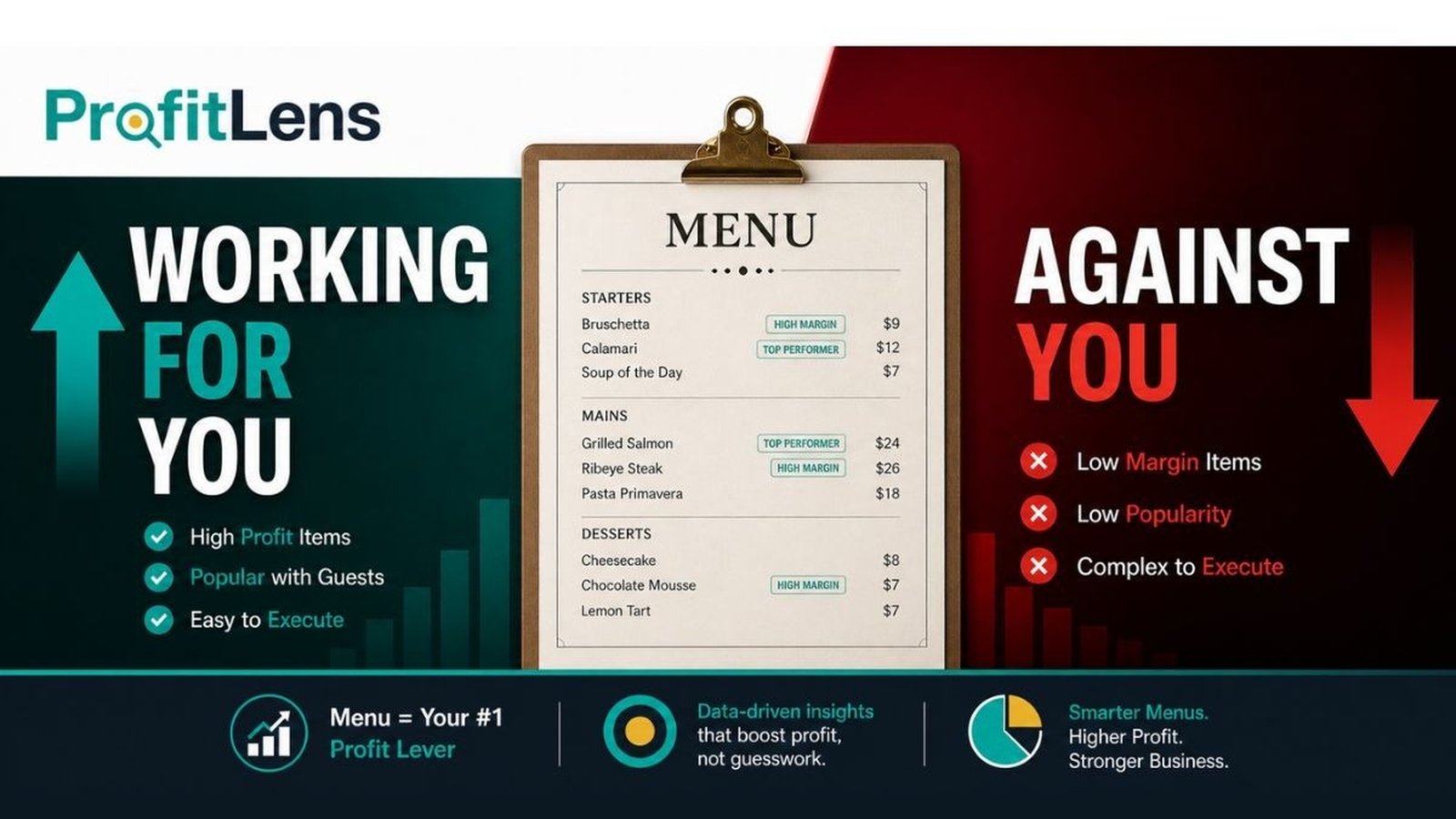
Is Your Menu Working for You Or Against You?
Here's a question most restaurant owners never ask: "Which of my menu items are actually making me money?"
Not revenue, profit. The real take-home after food cost, kitchen labor, waste, and packaging. Some of your most popular dishes might be your worst performers. Some of your least-ordered items could be your most profitable.
This is the core idea behind menu engineering, and once you see it, you can't unsee it. It's also the framework ProfitLens applies to every menu we analyze.
Your Menu Has Four Types of Items
Every dish on your menu falls into one of four categories based on two simple questions: do customers order it often, and does it make good profit when they do?
Stars: Your Best Friends
Stars are popular AND profitable. Customers love them, and you love serving them. These are the items you should protect at all costs. Never change the recipe, keep them prominently on the menu, and consider them untouchable. If anything, a small, careful price increase on a Star is usually safe.
Puzzles: Your Hidden Goldmine
Puzzles are high-profit items that don't sell enough. They're not unpopular because customers dislike them. They're underperforming because nobody's pointing at them. Move them to a more visible spot on the menu, add a photo, have your staff recommend them, and watch them climb.
Puzzles are the easiest profit wins available to any restaurant. You don't change the dish. You just change how visible it is.
Plowhorses: Loved but Lean
Plowhorses are popular dishes that just don't make much margin. Customers order them constantly, but the kitchen earns very little from each one. The goal isn't to remove them, since people would notice. The goal is to quietly improve the economics. A small price nudge, a modest portion adjustment, or a better deal from your supplier can turn a Plowhorse into something much more productive.
The math here matters. If a Plowhorse sells 200 times a month and you improve its margin by 50 cents per dish, that's $100 per month, $1,200 per year, from a single item. Across three or four Plowhorses, the numbers add up fast.
Dogs: The Quiet Drain
Dogs are low-profit AND low-popularity. They sit on your menu taking up space, confusing customers, and tying up kitchen resources. Most restaurants have a few. The strategy is simple: de-emphasize them first (smaller font, no photos, bottom of the menu), then fix them if possible, and remove them if they can't be saved.
Across the menus we analyze at ProfitLens, total recommended savings typically come in around 3% of monthly revenue. For a restaurant doing $80,000 a month, that's $2,400 found every month, often without changing a single dish.
The Items That Look Fine But Aren't
One of the most common surprises in menu analysis is discovering that a popular dish, one that flies out of the kitchen all day, barely covers its costs.
This happens when a dish is priced too low relative to what it costs to make. Food cost, prep time, waste, and packaging all eat into the margin before a single dollar reaches your pocket. A dish that generates a lot of revenue can still be a poor performer if the margin is razor-thin.
The fix is usually one of three things: raise the price slightly, find a way to reduce the ingredient cost, or redesign the recipe with a cheaper component. Often, a combination of all three is the most effective approach.
The key rule when testing a price increase: change one item at a time, watch sales carefully for two weeks, and be ready to roll back if customers push back. Patience and data beat gut feel every time.
Waste: The Profit Leak Nobody Talks About
Food waste is one of the most overlooked profit killers in the restaurant industry. Most kitchens are throwing away more than they realize, not through carelessness, but through habit. Batch sizes built around tradition rather than actual demand. Prep schedules that don't adjust to slower nights. Ingredients prepped days in advance that don't survive to service.
The solution starts with visibility. For five days, write down what you throw away each night. Just that. No changes yet, just observation. The pattern that emerges will tell you exactly where to focus.
Two habits that consistently reduce waste in any kitchen:
- Stop batch cooking in the last hour before closing. Use what's already in holding rather than cooking fresh.
- Match your prep quantity to your actual sales data, not to a round number or a feeling. One week of tracking real sales is worth a year of guessing.
Reducing waste doesn't happen overnight, but it compounds quickly. Small improvements each week add up to meaningful savings by the end of a quarter.
Menu Placement Is a Profit Strategy
Where a dish lives on your menu influences how often it gets ordered, sometimes more than the dish itself. Customers don't read menus the way they read books. Their eyes move in predictable patterns, and smart restaurants use that knowledge intentionally.
A few principles that consistently work:
- The first and last items in each section sell best. Use those slots for Stars and Puzzles.
- The top-right corner of a menu often gets strong attention. Put your highest-margin Puzzle items there.
- Photos increase orders significantly, but only add photos to high-margin items. Photographing a low-margin dish just drives more of the wrong sales.
- De-emphasize Dogs by moving them lower, using smaller text, and removing any photos or highlight boxes around them.
Your Staff Is Your Best Marketing Tool
No menu redesign is more powerful than a well-trained server saying "Chef recommends the salmon tonight." Staff recommendations drive orders in a way that no menu layout can fully replicate.
If you have high-margin Puzzle items that need more sales, the fastest way to move them is to brief your front-of-house team. Tell them which items you want pushed and why. Give them a simple line to use. Customers trust a genuine recommendation from a person far more than they trust a menu description.
This costs nothing. It just requires a five-minute conversation before each shift.
Where to Start: A Simple 90-Day Approach
Menu engineering doesn't require doing everything at once. In fact, trying to change too much too fast is one of the most common mistakes. Here's a sensible sequence:
Month One: Find and Fix the Obvious Problems
Identify your Dogs and your critically low-margin items. Test a small price increase on one Plowhorse. Start tracking waste for five days to understand where you're losing money on ingredients.
Month Two: Promote What's Already Working
Identify your Puzzles and give them visibility. Reposition them on the menu, brief your staff, post photos on social media. These changes cost almost nothing and can meaningfully shift your sales mix.
Month Three: Reduce Waste Systematically
By now you'll have real waste data. Use it to adjust prep quantities item by item. Focus first on the highest-waste items and work down the list. The savings here are often larger than people expect.
The Bigger Picture
A restaurant's menu isn't just a list of food. It's a business strategy written in plain sight. Every item represents a decision about where your kitchen's time, your supplier's ingredients, and your customers' attention will go.
Most menus grow organically over time. Items get added because someone liked them, because a chef wanted to try something new, because a competitor had something similar. Few menus are built with a deliberate eye on profitability.
The restaurants that thrive long term are the ones that treat their menu as a living document, something to review, refine, and optimize regularly. Not every item deserves a permanent spot. Not every popular dish is a good one. And not every change needs to be dramatic.
Small, intentional adjustments, done consistently, compound into significant results over a year. That's the real promise of menu engineering: not a single dramatic fix, but a series of smart, data-informed decisions that quietly transform how your business performs.
Frequently Asked Questions
What is menu engineering?
Menu engineering is the practice of analyzing each item on a restaurant menu by two factors: how often it sells (popularity) and how much profit it earns per sale (margin). Items are then sorted into four categories: Stars, Puzzles, Plowhorses, and Dogs. The goal is to make deliberate decisions about pricing, placement, promotion, and removal based on data instead of intuition.
How do I know which of my menu items are actually profitable?
You need to calculate the true margin of each dish, not just food cost. That means accounting for ingredient cost, kitchen labor time, waste, and packaging. Many popular dishes have surprisingly thin margins once all costs are included. ProfitLens analyzes each item across these dimensions and produces a profit ranking from most to least profitable.
What's the difference between a Plowhorse and a Dog?
A Plowhorse is popular but earns low margin. Customers love it, but the kitchen barely makes money on it. A Dog is both unpopular and low margin. Plowhorses are worth keeping and improving. Dogs are usually worth removing or redesigning.
How often should I review my menu?
A full menu engineering review every 6 to 12 months is a reasonable cadence for most independent restaurants. Between reviews, track waste and sales mix monthly so you spot drift early. Major changes (new suppliers, ingredient cost spikes, seasonal shifts) should trigger a faster review.
Will raising prices drive customers away?
Usually no, if increases are small and tested one item at a time. Most restaurants underestimate how much price elasticity their loyal customers tolerate. The standard test: raise one item by 50 cents to a dollar, watch sales for two weeks, and roll back if you see a clear drop in orders for that specific dish. Most price tests pass without issue.